
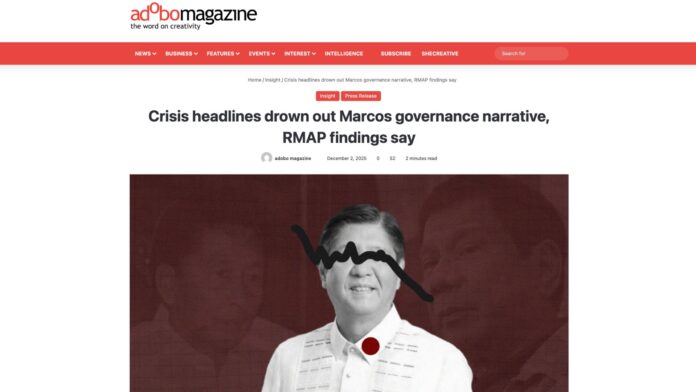
The Reputation Management Association of the Philippines (RMAP) released the results of a three-month national media scan conducted by PAGEONE Analytics and Insights (PAGEONE AI), revealing that crisis- and scandal-driven stories have almost completely overshadowed the Marcos administration’s broader governance agenda.
The PAGEONE AI scan, covering late August to November 2025, found that Philippine media has been dominated by corruption controversies, political infighting, economic anxiety, and security tensions. These include the flood control corruption scandal, the creation of the Independent Commission for Infrastructure, high-profile arrests, cabinet resignations, the Marcos–Duterte rift, the ICC custody of former president Rodrigo Duterte, the economic slowdown, and incidents in the West Philippine Sea.
RMAP warned that this imbalance in media framing deprives the public of a full understanding of how the country is being governed and noted that the administration has not done enough to communicate its broader programs outside these crises.
Key findings from the PAGEONE AI media scan
- Crisis narratives dominate national media. Flood control anomalies, political realignments, and security flashpoints command the bulk of news attention. Stories about investigations and infighting take precedence over policy substance.
- Governance programs and long-term reforms remain largely invisible. Initiatives in education, agriculture, climate adaptation, digital transformation, health, and economic competitiveness appear only sporadically. RMAP noted that if such programs exist but are not being covered, it raises questions about whether they are insufficiently implemented or inadequately communicated.
- Media salience shapes public perception of what matters. As crisis stories dominate the agenda, structural governance issues receive limited public attention. This affects how citizens form judgments about national leadership and how policymakers prioritize action.
- Communication gaps in the Marcos administration contribute to the imbalance. The scan suggests that the administration has not sufficiently articulated its governance agenda or provided clear, consistent communication on reforms beyond crisis response.
- Systemic issues remain underreported. Education quality, climate resilience, digital governance, institutional integrity, and long-term economic strategy do not receive sustained framing despite their national importance.
RMAP emphasized that the predominance of crisis coverage weakens public understanding of national priorities and undermines the capacity of government to demonstrate progress in areas that impact long-term development. The association added that reputation is shaped by both how crises are managed and how governance efforts are communicated.
When essential programs are not covered, citizens may assume they are absent or ineffective. Conversely, limited media framing may reflect editorial judgments that these programs are not yet substantial or newsworthy.
RMAP urged both government and media institutions to strengthen the depth, balance, and clarity of public communication in order to promote informed citizenship and a healthier democracy.
Dr. Ron Jabal, APR, Founder and President of RMAP, stressed, “The PAGEONE AI media scan confirms what many have sensed. The national information space is saturated with crisis, scandal, and political drama. What is missing is the governance narrative. The Marcos administration is not doing enough to inform the public about its reforms beyond crisis management. If the media is not covering these efforts, it means either the initiatives are not strong or the communication is not strategic. Either way, the public loses.”
He added, “What is given prominence shapes national priorities. If crisis stories dominate and governance stories disappear, the country risks losing sight of the long-term work needed to build trust, stability, and progress. RMAP calls for a more balanced information environment that strengthens public understanding of how the Philippines is being governed.”
About RMAP
The Reputation Management Association of the Philippines is the country’s leading professional body dedicated to advancing excellence in corporate, public sector, and institutional reputation management. RMAP promotes ethical standards, research, training, and strategic communication to strengthen trust and accountability across Philippine organizations.