
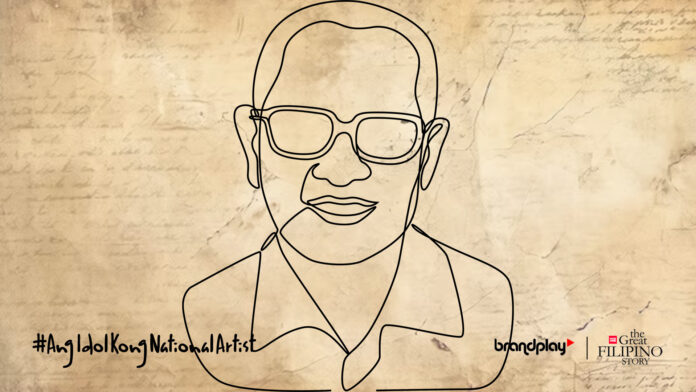
What is the true purpose of a writer? According to Amado V. Hernandez, it is to serve as the conscience of society and to affirm the enduring spirit of humanity, especially in the darkest of times.
Amado, a notable figure in Philippine literature, was more than just a writer. He served as the moral compass of society: a voice for the voiceless and a catalyst for social change. He used his pen to challenge the status quo, expose the injustices of his time, and inspire generations to strive for a fairer and more just society through his literary works.
Amado’s first pen
Amado began his literary journey at the age of 19. He joined the Aklatang Bayan literary society in 1922, a home to renowned Tagalog writers like Lope K. Santos and Jose Corazon de Jesus. This early exposure ignited his passion for literature and journalism.
Although he delved into the realms of journalism and literature, his academic pursuits led him to study Fine Arts at the University of Santo Tomas. Since his program was far from his passion in writing, he did not complete his degree.
A literary activist
Amado Hernandez was a prolific writer who worked as a reporter, columnist, and editor in various newspapers and magazines such as Watawat, Mabuhay, Pilipino, Makabayan, Pagkakaisa, and Sampaguita. Early in his writing career, he was already a vocal critic of social injustice and US imperialism.
Aside from being a journalist, he also delved into poetry and novels focusing on themes such as social commentary, revolutionary ideas, and national identity. His works emphasized the struggles faced by laborers and marginalized individuals, drawing from his activism experiences.
Hernandez’s dedication to social justice and national liberation remained unwavering, making him a catalyst of social change and cultural advocacy. As a journalist, he documented social-political events, while his poems and novels served as a medium for his sentiments, particularly in support of the struggles of the Filipino people.
Ka Amado
Besides being a writer, he was a prominent labor leader who dedicated himself to empowering laborers and advocating for social change. He was a key figure in the Congress of Labor Organizations (CLO) from 1945 to 1950, leading 49 rallies as the head of the organization. He also served as the voice of the laborers in their resistance against American control.
During World War II, Ka Amado courageously left his journalism career to join the resistance movement. He served as an intelligence operative for the guerilla warfare of Marking and Anderson, operating in Bulacan and the Sierra Madre mountains. Even after the war, his dedication to the labor cause remained unwavering as he continued to actively organize labor unions.
Continuing legacy in prison
Being an activist will not spare him from imprisonment especially when democracy in the society is threatened. He faced imprisonment from 1951 to 1956 due to his activities and writings. Regardless of being an inmate, he continued to display his leadership and artistic talents by initiating education programs and organizing musical productions, plays, and poetry readings.
During this time, he penned his notable works such as “Isang Dipang Langit”, “Bayang Malaya”, “Luha ng Buwaya”, and “Mga Ibong Mandaragit”. He also worked as the editor of the prison’s newspaper Muntinglupa Courier.
After spending five years in prison, Hernandez was granted bail by the Supreme Court on 20 June 1956. He then resumed his career in journalism and began writing a column for the Tagalog tabloid Taliba. From then on, his literary works were recognized with awards from prestigious literary contests.