
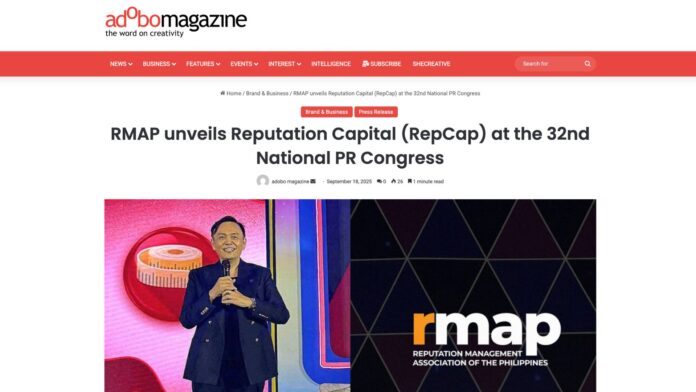
The Reputation Management Association of the Philippines (RMAP) officially launched Reputation Capital (RepCap) during the 32nd National PR Congress, an event attended by more than 400 public relations practitioners, communication leaders, and industry stakeholders from across the country.
RepCap is a groundbreaking framework created by Dr. Ron Jabal, DBA, APR, Chairman & CEO of PAGEONE Group and Founding President of RMAP. Ron, a multi-awarded PR and reputation management leader, developed RepCap to transform reputation from a “soft” intangible into a measurable and monetizable form of capital that organizations can bank, protect, and grow.
At its core, RepCap provides a formula that links stakeholder trust directly to business performance:

This formula demonstrates how reputation can be quantified and tied to financial outcomes, allowing PR practitioners to present reputation not as a cost center but as a strategic driver of enterprise value.
Components of the Formula
- Trust: the confidence stakeholders have in the organization’s integrity and purpose, measured through surveys, sentiment analysis, and employee engagement.
- Credibility: the perception of competence, reliability, and leadership, assessed via media analysis, investor confidence, and leadership visibility.
- Resilience: the organization’s ability to withstand and recover from crises, measured through risk audits, crisis response, and reputation recovery time.
- Risk: the weighted exposure to reputational threats such as product failures, governance lapses, social media volatility, or ESG scrutiny.
- Annual Revenue: the baseline business scale that allows reputation value to be expressed in peso terms.

Why It Matters for PR Practitioners
With RepCap, public relations professionals can:
- Defend budgets by showing the financial contribution of trust to revenue, valuation, and risk reduction.
- Prove ROI beyond visibility and engagement metrics by tying communication programs to measurable shifts in reputation value.
- Benchmark performance using trust, credibility, and resilience scores that boards and CFOs can understand.
- Elevate PR’s role from communications support to strategic enabler of growth, risk management, and governance.
According to Ron, “Reputation is no longer what people say behind your back. It is now a capital you can bank, trade, and lose in real time. RepCap empowers PR practitioners to put reputation where it belongs on the balance sheet.”